
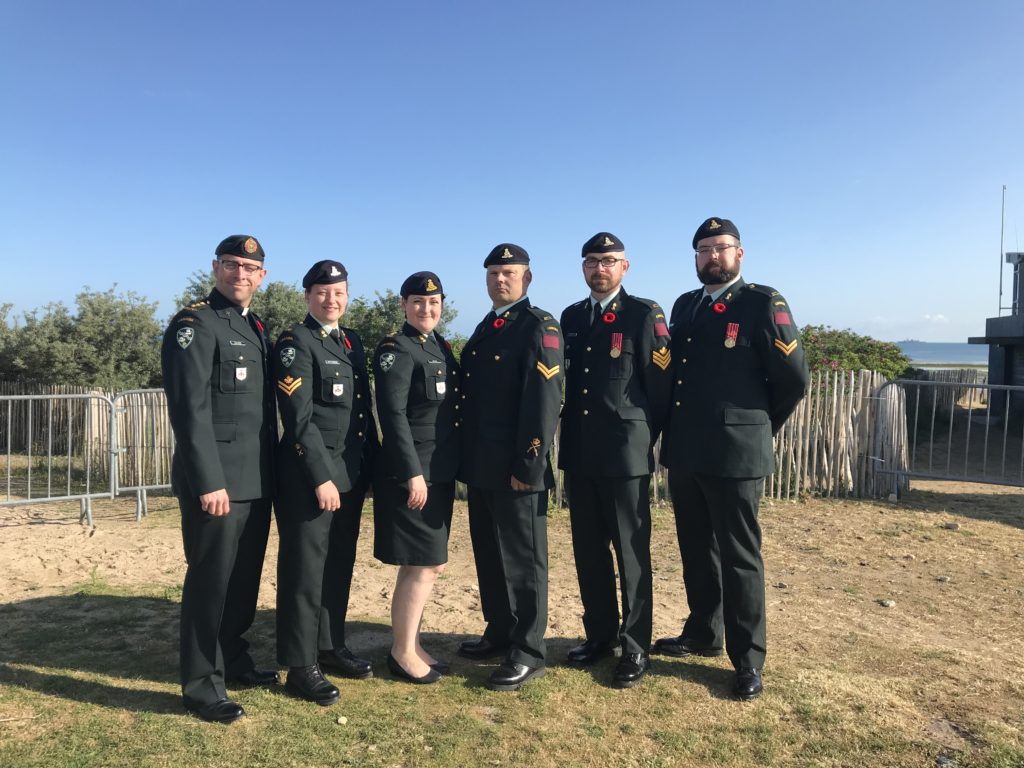
D-Day 75th Anniversary Tour
Written by Jannah Mead
On 6 June 1944, the Allied Forces launched a combined attack on the beaches of Normandy. This campaign, referred to as D-Day, marked the beginning of the end of World War II. On 6 June 2019, 75 years later, the world collectively gathered to commemorate this campaign with ceremonies and battlefield tours, allowing many to learn and understand the intricacies of the many battles, the magnitude of the human loss, and the sheer determination of those involved to bring an end to the war.
Fields of Fire Tours, organized by General David Patterson (Ret.), made a battlefield tour possible for many currently serving and retired members of the Canadian Armed Forces. Artillery members in particular were in attendance due to the special Artillery monument being unveiled at Point 67 (France) on the 8th of June 2019. A mix of 36 Reserve Force and Regular Force Members from across Canada were selected to attend, many of whom were sponsored in part or in whole by their units. The tour allowed all to participate in the 75th anniversary by visiting the locations of many of the key battles of World War II, as well as attending 4 official ceremonies; Bény-sur-Mer, D-Day on Juno Beach, Brentville-sur-Laize, and Point 67.
As the two groups moved from location to location, Gen. Patterson (Ret.), Dr. Alex Souchen, and Sara Karn recounted in great detail the units & members involved, the difficulty of many of the battles, and the fierceness of the enemy the Canadian Corps had to face. Their extensive knowledge of the war brought these battlefields to life for those listening as they recounted the names of men that risked everything to free France from their German oppressors. It was difficult for those listening to not be moved by the details they were hearing as they took in the now reconstructed homes and cleared beaches. It was hard to believe that these beautiful places had once been rubble, and instead of the sound of ocean and birds, they would have been living with the constant sound of guns, artillery shells, and the cries of the injured all around. A sobering thought as each member bowed his or her head for a moment of silence, surrounded by white marble tombstones as far as the eye could see, at more than one commemorative ceremony during the tour.
Visiting the many museums showed a glimpse of the magnitude of the destruction of homes and businesses 75 years ago. They also showed maps, equipment of the day, and video interviews with veterans describing their experiences on D-Day.
One particularly memorable location was the Abbaye d’Ardenne, where members learned that the 12SS Panzer Division, a German division led by Waffen SS General Kurt Meyer, executed 20 Canadian soldiers. The photos and biographies of these 20 soldiers were posted on a fence just several feet away from the patch of grass where the bodies were found buried at the end of the war. Unfortunately for the Canadian Corps, by the end of the Second World War, 10% of Canadian fatalities were from executions, the highest of any of the countries involved in the war.
The D-Day ceremony on 6 June at Juno Beach was particularly memorable. Having the 359 Canadian and French youth and cadets lay down boots, helmets, and flowers was a striking representation of the soldiers killed that day on Juno beach 75 years ago. With special music, the arrival of the veterans, the gun salute, and the laying of the wreaths by the prime ministers, those in attendance experienced a well thought out and heart felt ceremony, showing the utmost respect for those that fought and for those that lost their lives. The skill of the 3 actors that brought the thoughts and feelings of the soldiers and their families to life was a powerfully moving addition to the ceremony. Prime Minister of Canada, Right Honourable Justin Trudeau and Prime Minister of the French Republic Monsieur Édouard Phillippe each gave poignant speeches. Mr. Trudeau began by saying “14 000 Canadians stormed Juno beach that day, with no guarantee of victory. It was a gamble like the world had never seen before, but when duty called, Canadians from coast to coast to coast answered. On the battlefields of Normandy, Francophones, Anglophones, Indigenous peoples, new Canadians came together as one. One fighting force standing on guard for their British, American, and French Allies. … Standing on guard for Democracy, for liberty, for peace.” Monsieur Phillippe added that “It’s up to all of us to recount the dread and the tears, but also and above all, to take action and affirm our desire to live in peace, to live in the concord of nations, to live free.”
The ceremony at Point 67 marked a very significant day for the many Artillery members on the tour. As 6 artillery veterans were escorted to their seats, the soldiers on parade showed extra pride in their drill as the civilian attendees stood in a show of respect for the veterans’ service. Upon looking at these frail seniors, it was hard to believe that 75 years ago, at the age of 19 or 20, they had fought in these same fields to capture and hold Point 67. It was in honour of these 6 men, the 2000 men that lost their lives, and the many others that were unable to attend the ceremony that brought everyone together that day – to make it known that their sacrifice had not been forgotten. In honour of all Artillerymen that served, an Ordnance QF 25-pounder, the major British Field Gun and Howitzer during the Second World War, was placed on the hill.
One of the last places visited was a German cemetery called La Cambe. There was an obvious difference in the appearance and the feel of the cemetery. Although the tour guides reminded the group that there were war criminals buried here and to not forget that this was the enemy, there was still a feeling of regret and sadness walking through the cemetery. How many had been conscripted? How many had been forced to fight or lose their lives? How many had been brainwashed as Hitler youth? This cemetery was also a true testament of the French people and their heart of forgiveness, after being occupied by the Germans, to allow them a piece of French soil for their dead soldiers. Prime Minister Édouard Phillippe reinforced this evidence of forgiveness in his speech at Juno Beach, “We will not forget the young German men who fell on the beaches,” Phillippe said. “In 1944 they were enemy soldiers. Today, they too have found a final resting place here. Their children, their grandchildren, are not just our allies. They are our friends.”
It was a life changing experience for all that attended. The knowledge gained and the chance to see and touch the many monuments and the sand of the beaches in Normandy will leave a lasting impression for years to come. It is also important to note that commemorating this event is necessary. In the not so distant future, the veterans will be gone and if we are to avoid repeating our past mistakes, we must first be sure to remember the past, the sacrifices of others, and the need to forgive.
Lest we forget.